
Poland Took 46% More Whole Salmon. Selected Fillet Exports Rose 22%.
Norway is exporting record salmon volumes, and much of the current market discussion is focused on where the additional fish is being absorbed. China is one obvious growth story. But Poland — Norway's largest salmon destination — raises a different question: what happens after the fish crosses the first border?
Record supply is finding buyers
Norway exported a record 165,393 tonnes of salmon in September, up 22% year on year.
Two markets stood out.
Norwegian salmon exports to China increased 43%, reaching 11,420 tonnes. Poland received 32,296 tonnes, up 30%, making it Norway's largest salmon destination.
China has understandably attracted attention. The growth in Norwegian exports there helps explain how part of the additional supply is being absorbed.
But Poland is different.
Poland is not simply an end market for Norwegian salmon. It is one of Europe's most important salmon-processing and redistribution hubs.
That means strong Norwegian exports to Poland tell us where the fish is going first — not necessarily where it is ultimately being consumed.
Look one border further
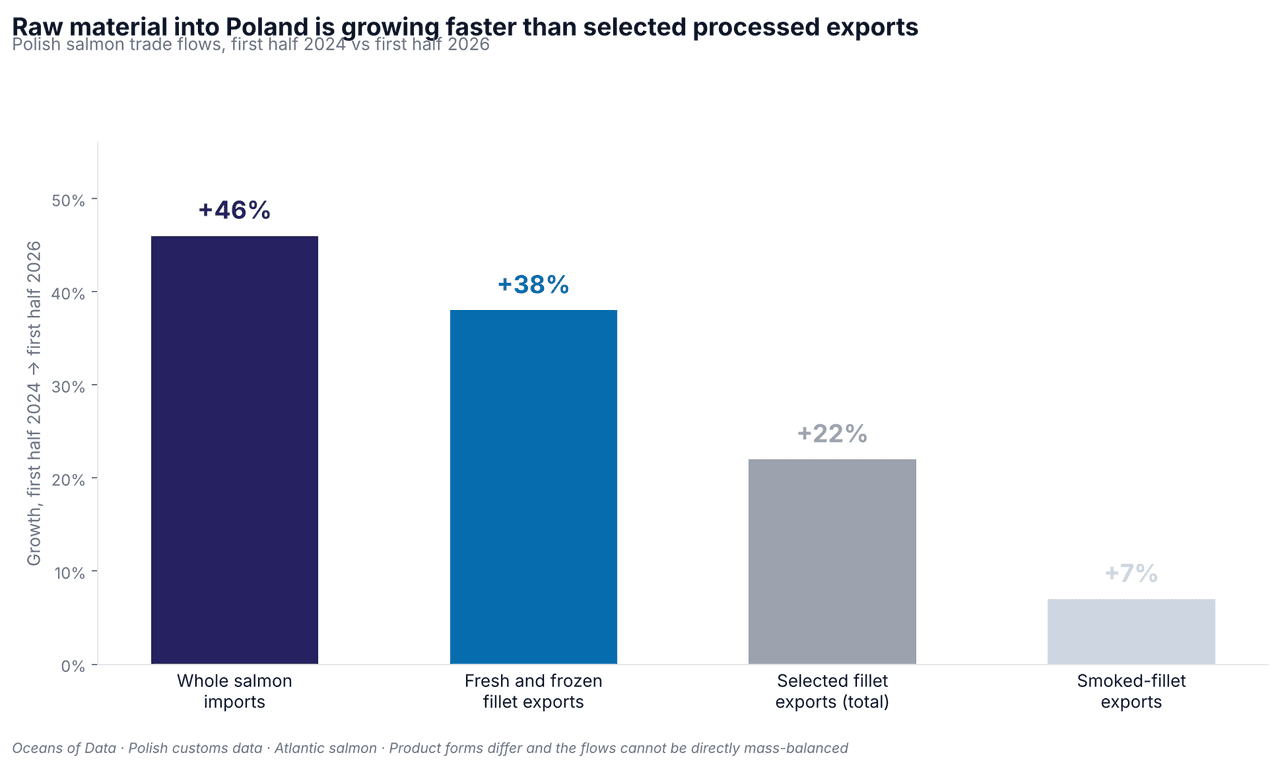
In the first half of 2026, Poland imported 105,337 tonnes of fresh and frozen whole Atlantic salmon, up 46% from the first half of 2024.
Over the same period, Polish exports of selected smoked, fresh and frozen salmon fillets increased from 52,658 tonnes to 64,268 tonnes.
That is growth of 22%.
But the composition matters.
Exports of fresh and frozen fillets increased from approximately 25,135 tonnes to 34,706 tonnes — growth of around 38%.
Smoked-fillet exports increased by only 7%.
So the picture is:
- Whole salmon imports: +46%
- Fresh and frozen fillet exports: +38%
- Selected fillet exports overall: +22%
- Smoked-fillet exports: +7%
This does not mean that 46% more raw material should translate directly into 46% more fillet exports.
Product weights, processing yields, product mix, domestic consumption, whole-fish re-exports and other salmon products all matter.
But the divergence is still informative.
The fastest growth is occurring in the raw material entering Poland.
That makes Poland an important market to examine when asking one of the key questions facing the salmon industry today:
Where is Norway's additional supply ultimately being absorbed?
Methodology note: Import and export tonnes are reported in different product forms and cannot be directly mass-balanced. The export comparison covers selected smoked, fresh and frozen fillet categories, not every salmon product handled in Poland. No inventory or processing-yield conclusion is drawn.
Why this matters now
Norwegian supply is exceptionally high.
In week 40, Norway exported 30,149 tonnes of fresh salmon, 28.3% more than in the corresponding week of 2025.
The average export price was NOK 74.39/kg — 5% below the same week last year and around 7% below the 2026 year-to-date average.
Poland again played a major role.
Oceans of Data recorded approximately 7,814 tonnes of fresh whole salmon and fresh fillets shipped to Poland in week 40, compared with a forecast of approximately 5,163 tonnes.
Actual volume was therefore around 51% above forecast.
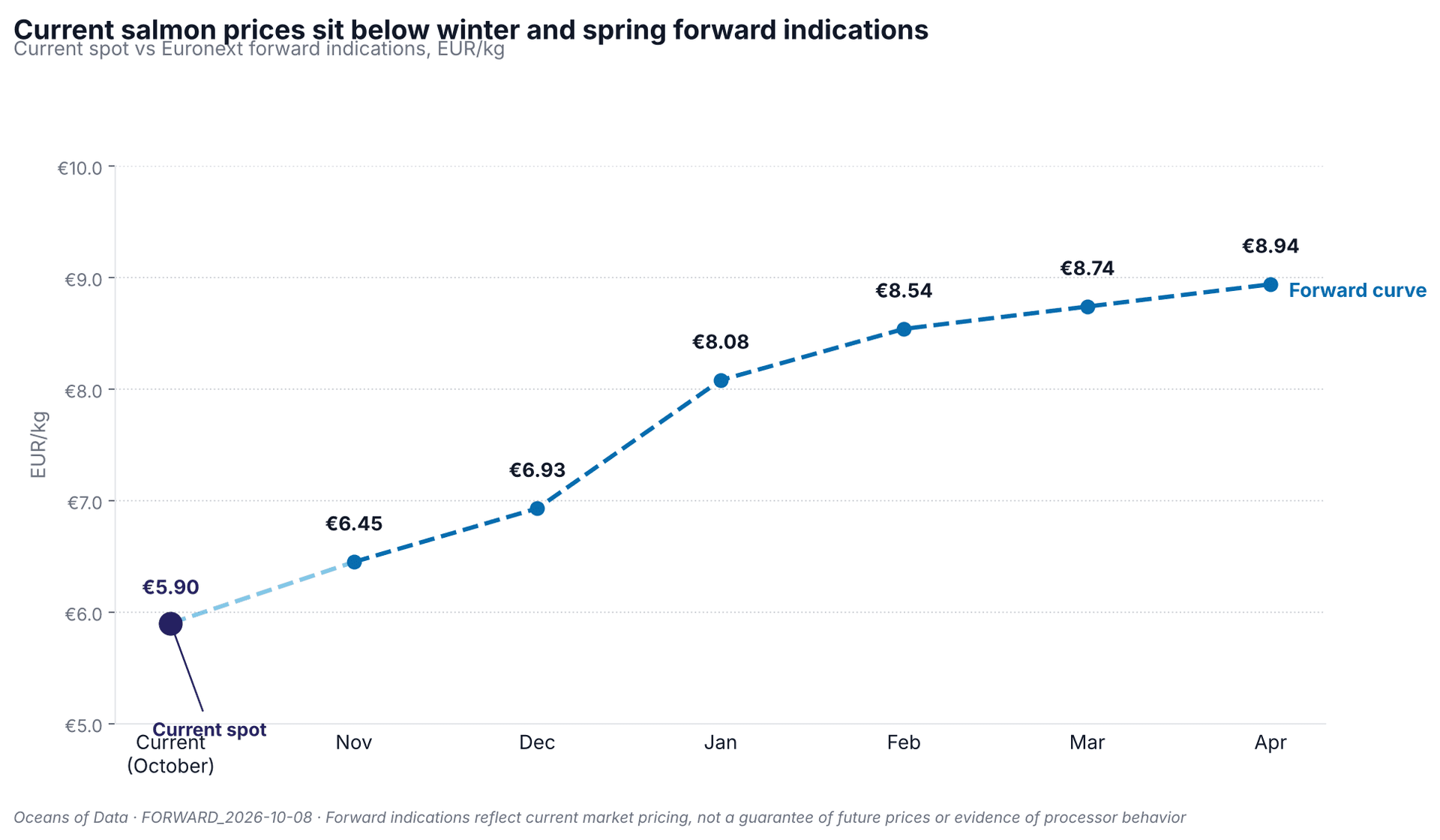
Meanwhile, the forward curve points materially higher.
October is indicated at around €5.90/kg, rising to €6.45 in November, €6.93 in December and €8.08–€8.94 from January through April.
That raises another question:
Is Poland absorbing more salmon because downstream demand is growing — or are processors taking advantage of abundant fish at prices below the 2026 average while the forward market points higher?
The trade data cannot answer that question.
Nor does the forward curve prove that Polish processors are building inventories. It may partly reflect normal seasonality, while current purchases can support immediate processing, freezing, smoking or existing customer programs.
But the market conditions are clear: supply is abundant, current prices are below the 2026 average and forward indications are materially higher later in the season.
Viewed from Norway, exceptionally strong exports to Poland look like exceptionally strong demand.
Yet a tonne shipped from Norway to Poland has left the Norwegian physical market. It has not necessarily reached the final consumer.
It may become fresh or frozen fillets. It may become smoked salmon. It may be redistributed in another form, consumed domestically or move further through the European value chain.
To understand demand, the fish may need to be followed beyond the first border.
The smoked-salmon signal
Smoked salmon provides the clearest contrast.
Polish smoked-fillet exports increased from 27,523 tonnes in the first half of 2024 to 29,562 tonnes in the first half of 2026.
That is growth of only 7%.
Germany — the largest destination — took 15,036 tonnes, compared with 14,202 tonnes two years earlier.
Growth was approximately 6%.
This does not mean European salmon demand is weak.
The 38% increase in Polish fresh and frozen fillet exports shows substantial downstream growth in other product categories.
But the additional raw material entering Poland is not appearing evenly across traditional downstream channels.
That makes the distinction between destination demand and final demand increasingly important.
The question is moving downstream
The salmon market has absorbed extraordinary Norwegian volumes without the price collapse that might normally be associated with such rapid supply growth.
China is clearly part of that story.
Poland is part of it too.
But Poland illustrates why headline destination growth requires interpretation.
The first question is:
Where is Norway exporting more salmon?
The more important question may be:
Why is the fish moving — and where is it ultimately being consumed?
With unusually high volumes moving through the market today, following the fish beyond the first border may tell us more about the strength of demand than the first export destination alone.
Anna Björk Theodórsdóttir
Founder & CEO