
Fresh Whole Salmon Emerges as the Bright Spot in a Flat US Market
Norwegian fresh whole salmon exports to the United States have held above August levels into the autumn.
1. What changed?
US salmon imports grew just 0.4% year-on-year during January–August 2026, a sharp slowdown from the 6.6% growth recorded between 2024 and 2025. At the same time, average import prices continued to soften, declining from USD 11.72/kg to USD 11.29/kg — the second consecutive annual decrease, down from USD 12.34/kg in 2024.
While total import volumes changed little, the composition of imports shifted meaningfully. The story in 2026 is less about overall market growth and more about changing product mix.
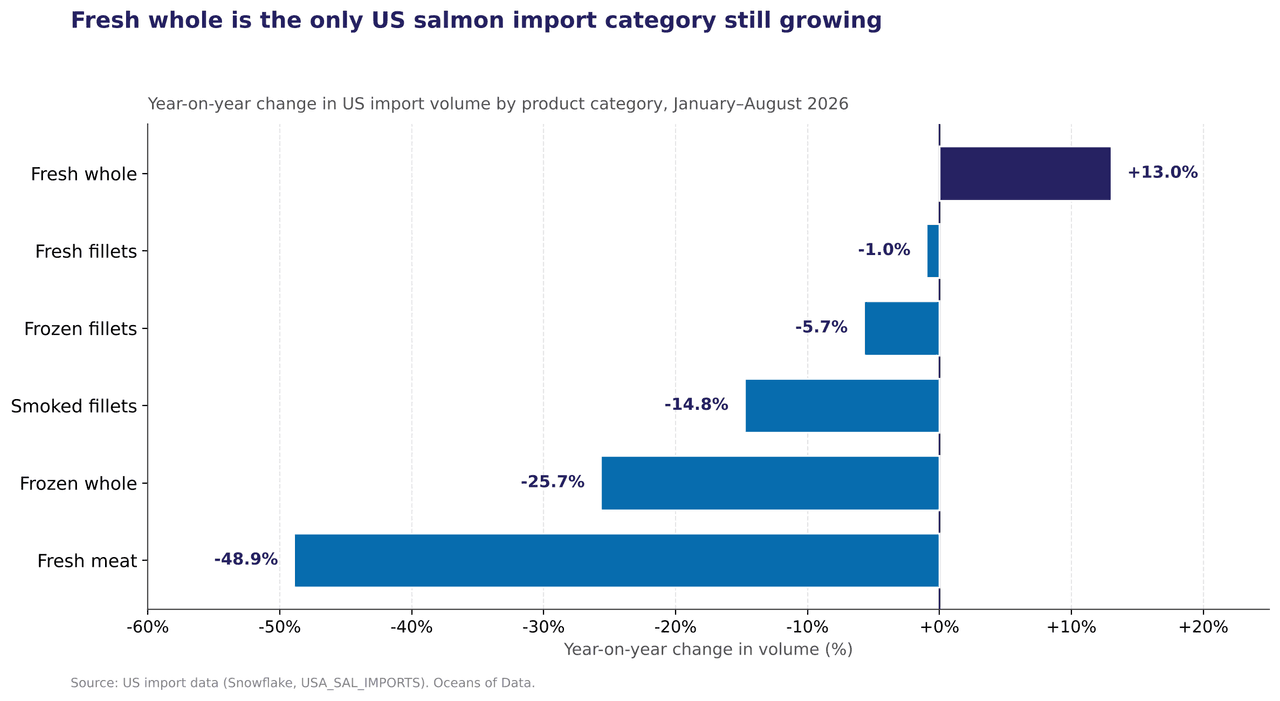
Fresh whole salmon imports increased 13.0% to 102,138 tonnes, making it the only major product category to post significant growth. Meanwhile, all other leading categories declined:
• Fresh fillets: –1.0%
• Frozen fillets: –5.7%
• Smoked fillets: –14.8%
• Frozen whole salmon: –25.7%
• Fresh salmon meat: –48.9%
2. Why does it matter?
Fresh whole salmon accounted for 30.8% of total US salmon imports during January–August 2026, the highest share recorded in the past three years. The comparable figures were 27.3% in 2025 and 29.3% in 2024.
The increase is not dramatic, but it suggests fresh whole salmon is regaining share within the US import mix at a time when overall market growth has largely stalled.
The shift is not occurring evenly across suppliers. Atlantic salmon imports from Canada increased 23% year-on-year, largely returning to 2024 levels after a weaker 2025. Imports from Chile rose 4.5%, while imports from Norway declined 16.3%, driven primarily by lower fillet shipments rather than fresh whole fish.
Price trends reinforce the signal. Import prices for fresh whole salmon increased 3% in 2026 to USD 9.21/kg, partially reversing the decline seen in 2025. By contrast, processed salmon products moved in the opposite direction. Average prices across fillets, smoked products and other processed categories fell a further 4% to USD 12.25/kg.
In other words, the category gaining volume is also seeing firmer pricing, while categories losing market share are becoming cheaper.
3. What could this mean?
If current trends continue through the remainder of the year, demand growth in the US market may be becoming increasingly concentrated in fresh whole salmon rather than processed categories.
Recent Norwegian export data supports this interpretation. Fresh whole salmon exports to the US are estimated at approximately 1,583 tonnes in September 2026, compared with 732 tonnes in September 2025 and 1,634 tonnes in September 2024. October exports are currently tracking at roughly 1,824 tonnes, above both October 2025 (1,026 tonnes) and October 2024 (1,622 tonnes). The October figure combines one week of confirmed exports (W41) with three weeks of forecast data (W42–W44).
The significance is not simply the higher volumes, but the seasonal pattern. Norwegian exports to the US typically decline sharply after the August peak. In 2026, that slowdown appears less pronounced than normal.
Pricing has remained supportive as volumes have risen. Between June and August 2026, FOB prices for Norwegian fresh whole salmon increased from USD 7.76/kg to USD 8.78/kg, while export volumes rose from 1,201 tonnes to 2,579 tonnes. Seasonal factors undoubtedly play a role, but the combination of higher prices and higher volumes suggests demand remained robust during the period.
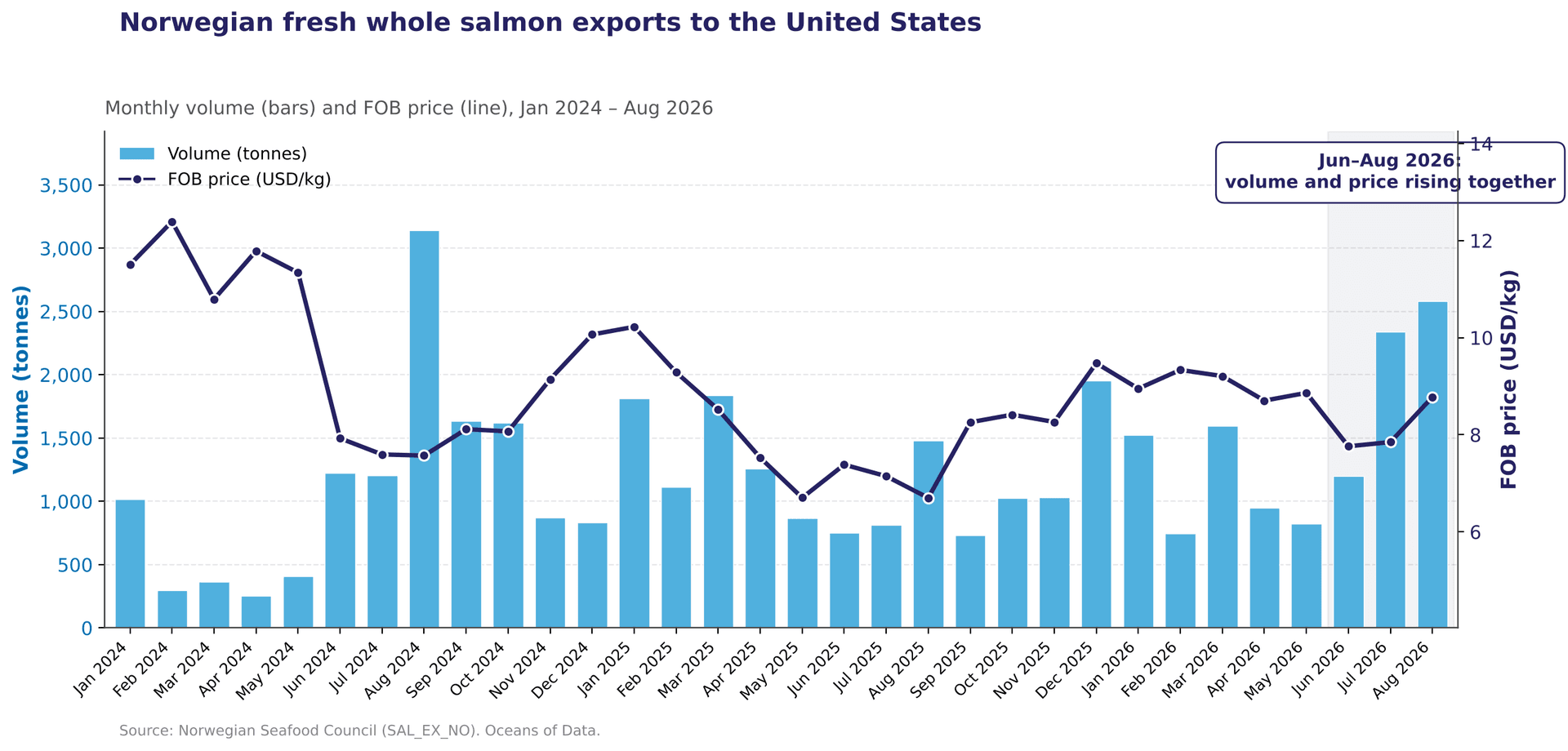
Taken together, the data points toward fresh whole salmon strengthening its position within the US market. It is currently the only major category generating meaningful volume growth and one of the few product forms where pricing has firmed rather than softened.
4. Watch next
• Does fresh whole salmon continue to gain share of the US salmon market through Q4?
• Does demand for fresh fillets stabilize or continue to weaken?
• Do prices for fresh whole salmon remain firm while processed product prices continue to soften?
• Do Norwegian fresh whole salmon exports to the US maintain their stronger-than-normal post-August seasonal pattern?
• Does the gap between Canadian and Norwegian performance in the US market persist?
5. Bottom line
The US salmon market is not growing much in 2026. What appears to be changing is how salmon enters the market.
Fresh whole salmon is currently the only major category posting meaningful volume gains, while also showing firmer pricing than processed products. Whether this proves to be a temporary shift in product mix or the beginning of a longer-term change in US buying patterns should become clearer as Q4 data emerges.
Anna Björk Theodórsdóttir
Founder & CEO