
Raw Material Prices Are Rising Faster Than Product Prices. Is That Sustainable?
Raw cod is getting costlier by the quarter, while export prices have held in a narrow +15–17% band so far this year.
1. What changed?
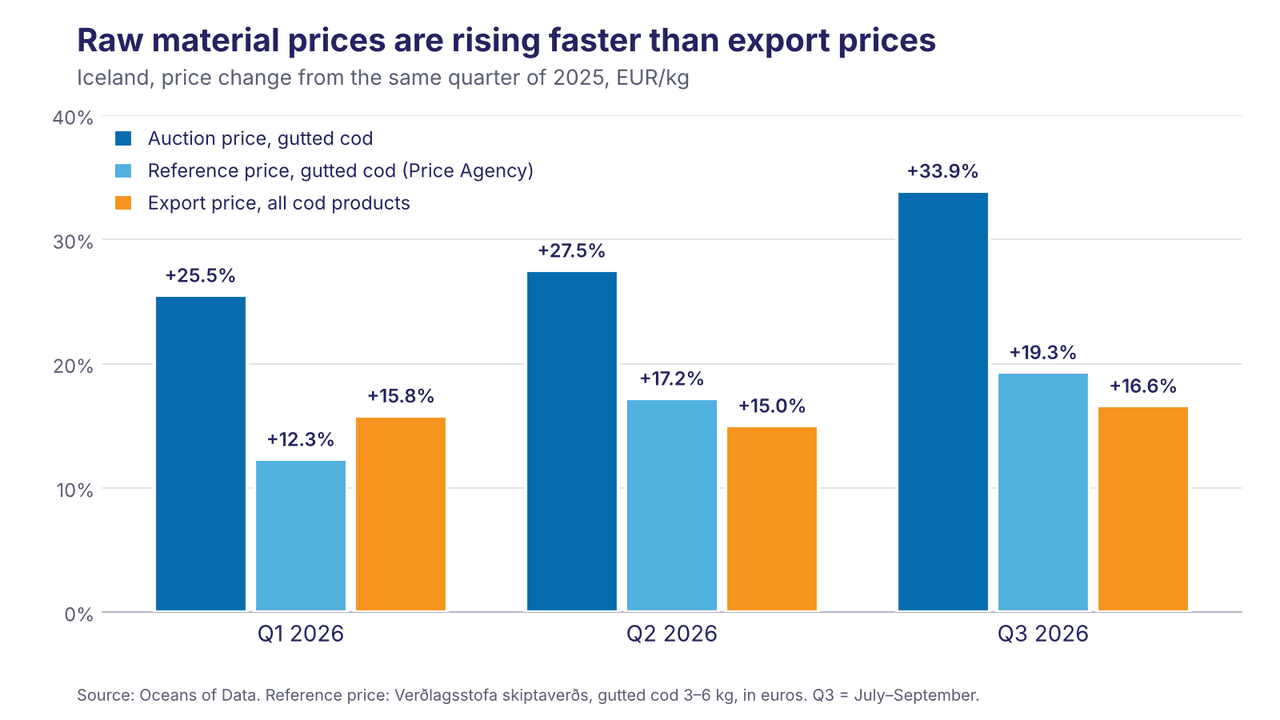
Between January–August 2025 and the same months of 2026, the price of Icelandic gutted cod at auction went up 28.7%, from €3.93 to €5.06/kg. In Norway, fresh gutted cod climbed 35.8%, from €6.25 to €8.49/kg.
The Price Agency’s reference price (Viðmiðunarverð Verðlagsstofu skiptaverðs) for gutted cod, 3–6 kg, moved later but is now moving faster. Year on year it was up 12.3% in the first quarter, 17.2% in the second and 19.3% in the third.
Across all cod products, Iceland’s average export price increased 15.9% in January–August, from €9.07 to €10.50/kg. Quarterly growth has remained remarkably stable at 15.8%, 15.0% and 16.6%.
What fish is in the numbers: Norway, auction: fresh whole cod, gutted (about 90% headed and gutted, about 10% gutted with head). Iceland, auction: gutted cod with head. Both are gutted fish, not ungutted. Reference price: the Price Agency’s settlement price in euros, not the auction price.
2. Why is it happening?
Global supply of wild cod fell 37.5% from 2017 to 2024, from about 1.3 million tonnes to about 0.8 million.
In the Barents Sea, the largest Atlantic cod stock, the quota has been cut from 890,000 tonnes in 2017 to 285,000 in 2026, and Iceland’s advised catch for 2026/27 is 26% below 2019/20.
Less supply. Higher prices. The market is responding to the basic laws of supply and demand.
Auction prices reacted first. From 2021 to 2026 (the 2026 average runs from January to early November), the Icelandic auction price for gutted cod has gone up every single year, from €2.38/kg to €5.00/kg.
That is 110% more, and the highest annual average in the period.
The reference price follows the auctions and has been catching up quarter by quarter.
3. Why does it matter?
Until 2024, product prices roughly kept pace with raw material costs, and processing margins held (EBITDA 18.1% in 2021, 19.2% in 2024, all fish processing). Since 2025, raw material prices have been rising faster.
In the first quarter, the reference price was up 12.3% against 15.8% for export prices. By the third quarter it was ahead: 19.3% against 16.6%.
At the same time, Iceland’s price premium over its competitors is shrinking.
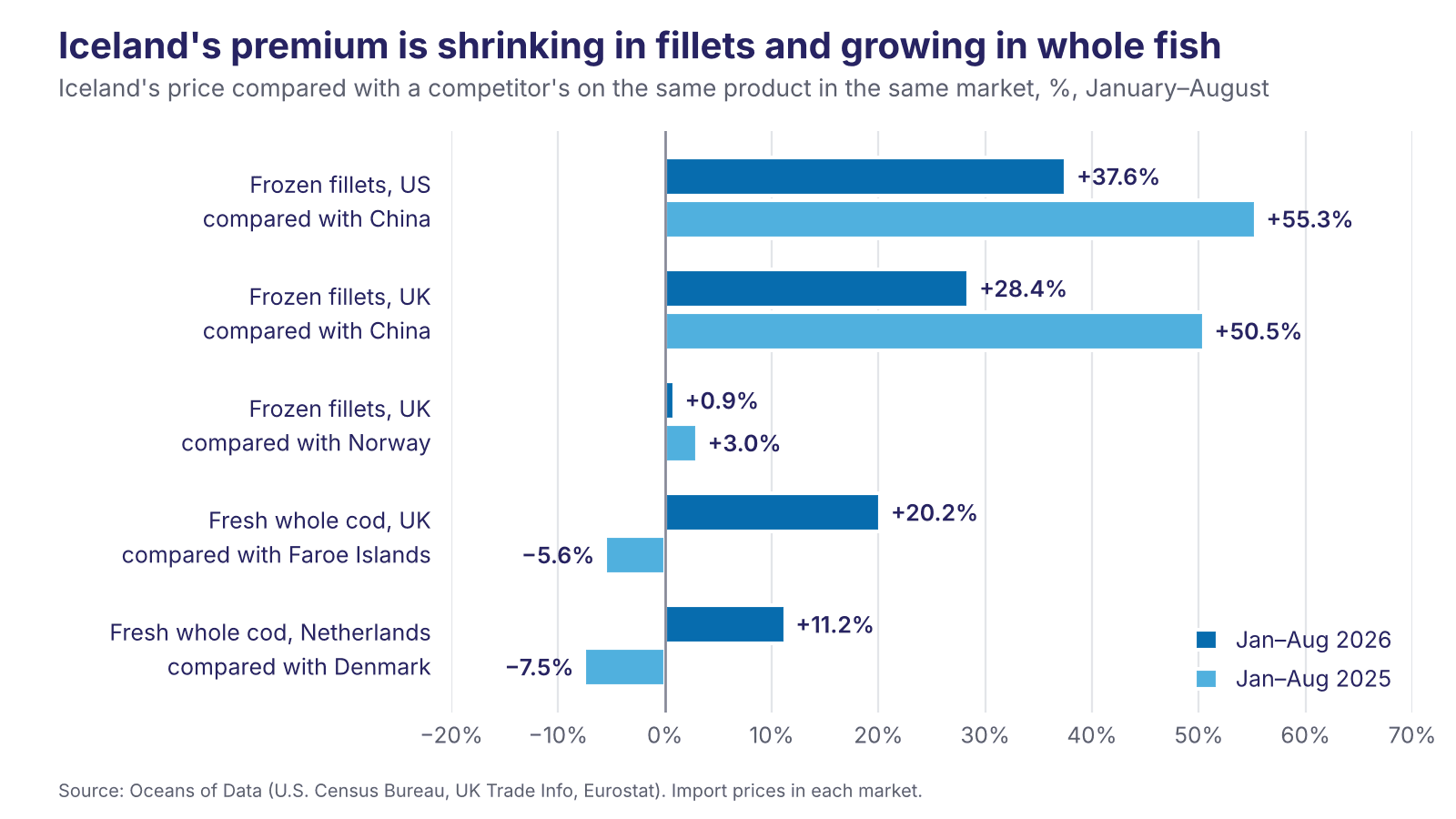
The premium is how much more per kilo Iceland gets than a competitor selling a similar product to the same market (January–August, 2025 against 2026):
Frozen fillets, US market
Iceland’s price was 55.3% above China’s (€12.31 against €7.93/kg). This year it is 37.6% above (€14.85 against €10.80). China’s price went up 36.2%, Iceland’s 20.6%.
Frozen fillets, UK market
50.5% above China, now 28.4% above. Against Norway, 3.0% above, now 0.9%, so practically the same price.
Fresh whole cod, UK market
Iceland was 5.6% below the Faroe Islands and is now 20.2% above.
Fresh whole cod, Netherlands
Iceland was 7.5% below Denmark (€5.91 against €6.39/kg) and is now 11.2% above (€7.58 against €6.81).
In fillets, Iceland still earns a premium, but a smaller one. In fresh whole fish, the raw material, Iceland has gone from cheaper than its competitors to more expensive.
My interpretation is that the price pressure is becoming increasingly concentrated at the raw material end of the value chain.
4. What to watch next
Product prices
Whether export prices continue to rise at roughly 15–17%, or start accelerating to keep pace with raw material costs.
The reference price
Whether the reference price continues to rise faster than export prices.
2027 supply
The Barents Sea quota goes up 14% to 325,000 tonnes, while Iceland’s advised catch goes down 1.1%.
Bottom Line
Raw material at auction is up 29% in Iceland and 36% in Norway. The reference price in Iceland is catching up, while export prices have remained in a narrow +15–17% range so far this year.
My reading is that there is limited room for raw material prices to keep rising without pressure appearing elsewhere in the value chain. That pressure is likely to show up in product prices, processing margins, or both.
The Barents Sea quota is set to increase 14% in 2027, while Iceland’s advised catch is set to decline 1.1%. More supply from the Barents Sea could ease some of the pressure on raw material prices. That is my interpretation, not a measurement.
At Sjávarútvegsdagurinn last week, Ragnar Nystøyl of Kontali showed that the share of European consumers who say fish is too expensive rose from 14% in 2016 to 26% in 2024.
Raw material prices have been rising faster than product prices since 2025. The question now is whether product prices catch up, or margins come under pressure.
— Anna Björk, Oceans of Data
Anna Björk Theodórsdóttir
Founder & CEO