
Salmon Prices Are Rising. Norway’s Supply Is Still Running High.
Our forecast keeps Norwegian salmon exports above 32,000 tonnes a week through W50. The next test is whether demand can keep absorbing the volume and where it goes.
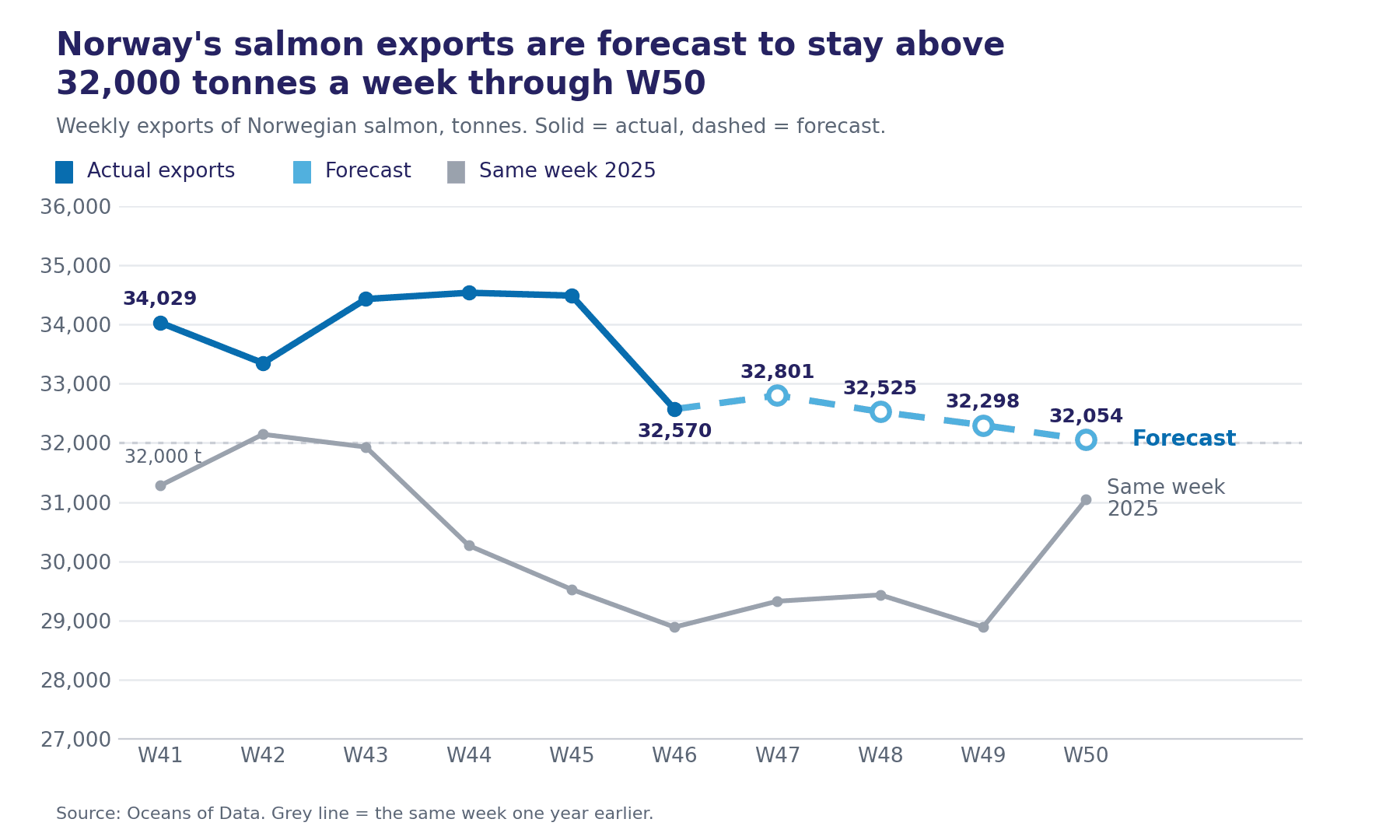
Correction, 22 Nov: The original W46 export total excluded frozen fillets and used an earlier version of our export series. The corrected figure is 32,570 tonnes, up 12.7% year-on-year. The forecast figures and accuracy comparison below have been updated to include frozen fillets.
What happened
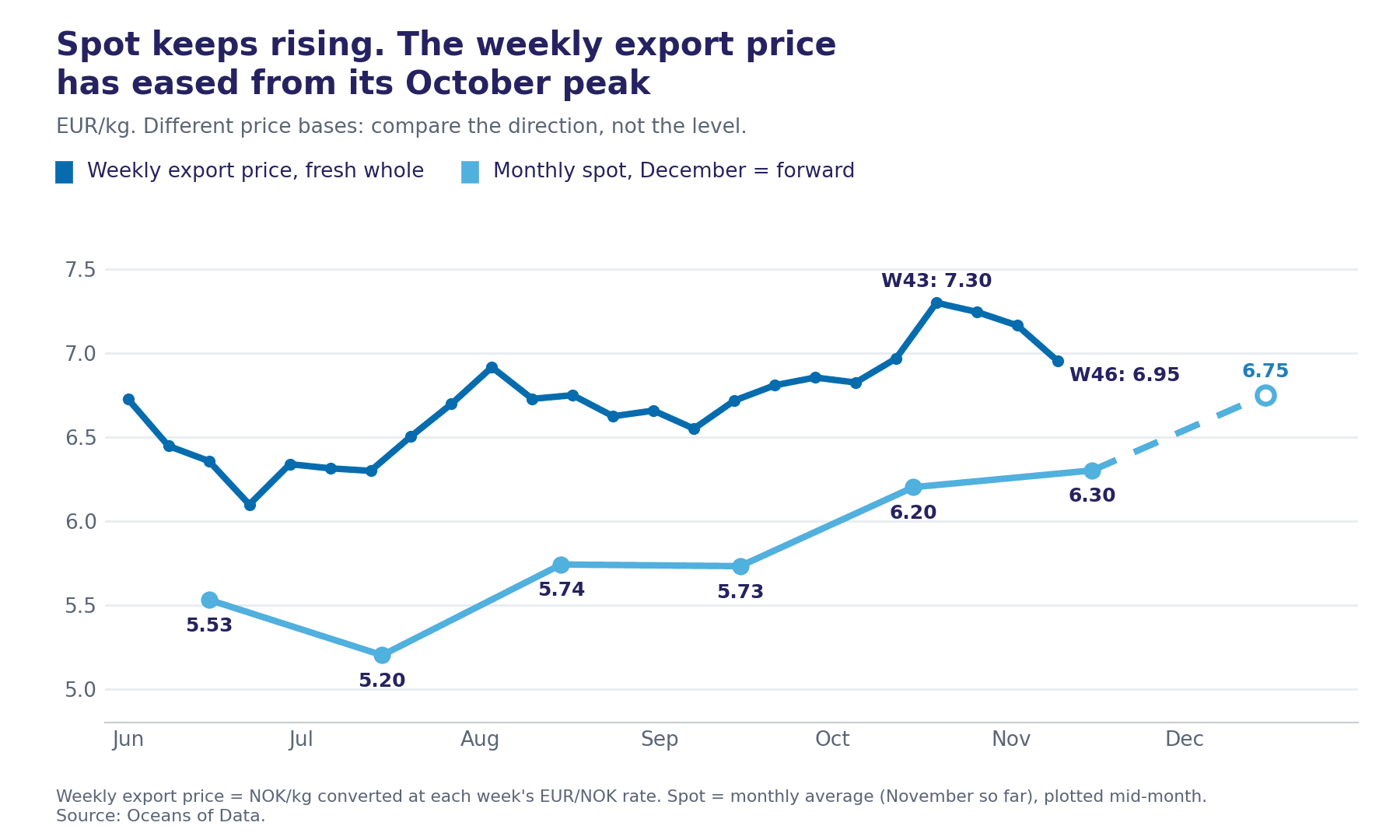
Norwegian salmon spot prices have risen month by month since September. The monthly average increased from EUR 5.73/kg in September to EUR 6.20/kg in October and EUR 6.30/kg so far in November. The forward curve puts December at EUR 6.75/kg, 7.1% above the November level.
The weekly export price for fresh whole salmon is a different price measure. Since W41, it has remained within a relatively narrow range of NOK 73.24–76.66/kg. In W46, it was NOK 73.53/kg, down 1.5% from the previous week. In euros, the weekly export price peaked at EUR 7.30/kg in W43 and was EUR 6.95/kg in W46.
But supply remains high.
Norway exported 32,570 tonnes of salmon in W46, 12.7% more than in the same week last year. Our forecast keeps weekly exports between 32,054 and 32,801 tonnes through W50, or 3.3% to 11.8% above the corresponding weeks of 2025.
That is high for this time of year. Over W41–W46, weekly exports averaged about 33,900 tonnes, roughly 3,200 tonnes a week more than in the same weeks of 2025. Our forecast points to a higher supply level heading into December than the market saw a year ago.
Activity at Norwegian production sites points in the same direction. We recorded 146 well-boat visits associated with harvesting in W46, 47.5% more than a year earlier. These visits are an indicator of harvesting activity rather than harvested tonnes, and production-site activity is one of the signals feeding into our export forecast.
Why it matters
The market is now testing whether demand can absorb higher prices alongside high year-end volumes.
Norway exported 154,030 tonnes of salmon in October, 8.3% more than a year earlier. Poland received 32,350 tonnes, up 14.5%, and remained the largest destination market. China also remains an important growth market, although year-on-year growth slowed to 11.4% in October from 41.2% in September.
So far, the evidence points to demand absorbing high supply, rather than a shortage of fish driving the market.
If prices continue to rise while exports remain around 32,000 tonnes a week, that becomes the more interesting story: the market is absorbing high volumes while prices keep climbing.
What to watch next
Three things matter now:
- whether exports remain above 30,000 tonnes in W47 and W48 while forward prices point higher;
- whether Poland continues to absorb a large share of the additional volume; and
- whether China continues growing or the slowdown seen in October carries into the final weeks of the year.
If volumes remain close to our forecast and prices continue higher, demand is absorbing the elevated supply without stopping the price rise.
If volumes begin to fall while prices continue higher, the balance changes: tighter supply becomes a more important part of the price story.
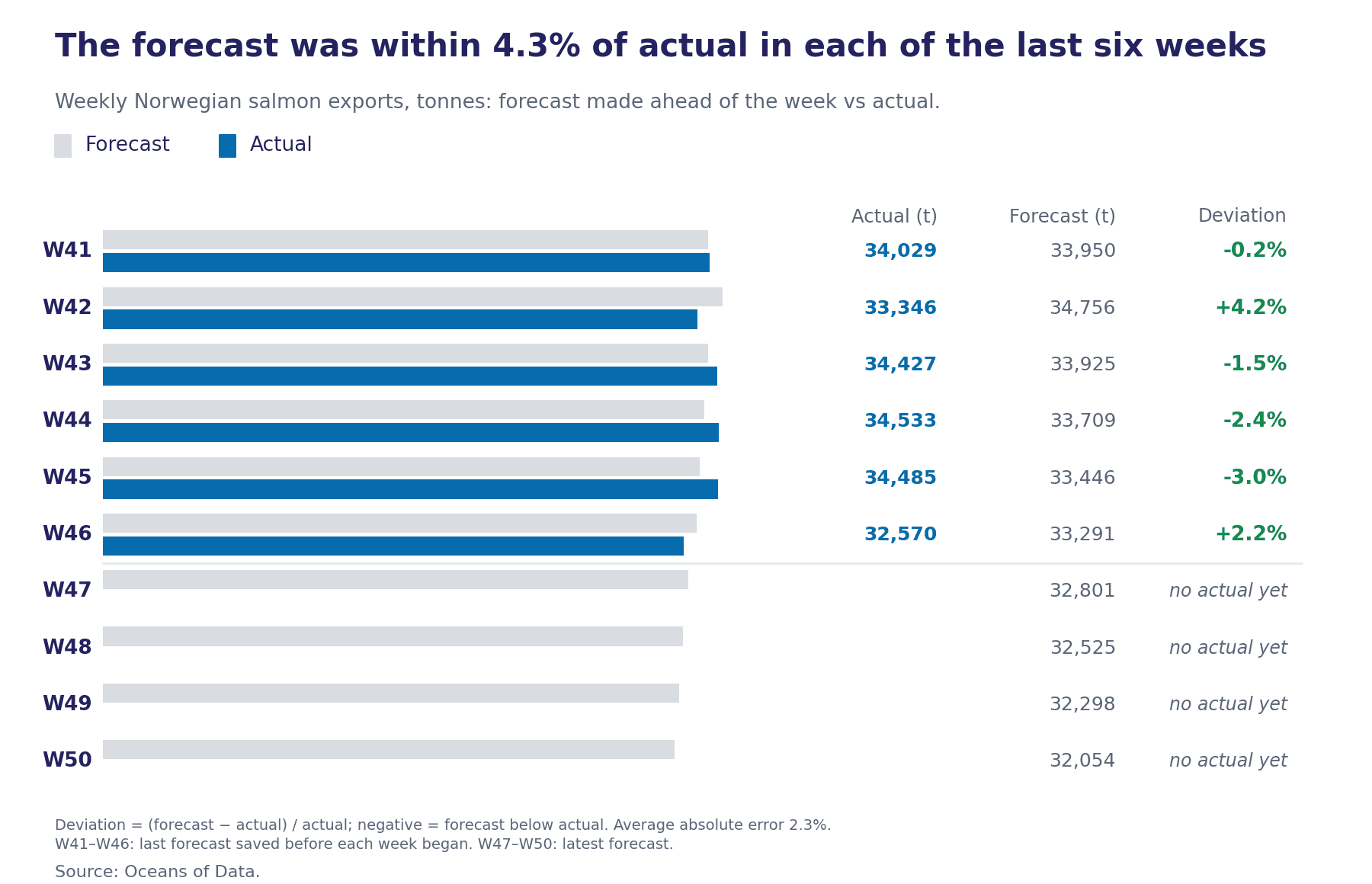
Across W41–W46, the forecast stayed within 4.3% of actual exports each week, with an average absolute error of 2.3%.
W47 is the next test.
Anna Björk Theodórsdóttir
Founder & CEO